| …attractive piece of musical fluff … a nice encore piece … very effectively laid out… | ||
| — Musical Opinion |
Click the quotation text to discover what it refers to!
| …attractive piece of musical fluff … a nice encore piece … very effectively laid out… | ||
| — Musical Opinion |
Click the quotation text to discover what it refers to!


Fand IncWessex Press is a publisher of high quality sheet music, CDs and books, all focussing on accessible 20th Century and contemporary composers and concentrating mainly on first editions. Please use the tabs at the top of the page to explore the catalogue. Further details, such as information about ordering, can be found on the Contact/Info page.
This is a setting of lines from Coleridge Taylor’s beautiful poem, The Nightingale, and aims to capture the mystical and dream-like quality of the original. Alternating sections of stillness and movement are punctuated by bird-like sounds from the solo flute.
Edward Thomas (1878–1917) is best known as a poet but was unusual in that he only started writing verse near the end of 1914 at the relatively late age of 36. Prior to that he had some success since 1897 as a prolific critic, biographer, writer on travel and nature and – with a single title to his credit – novelist. Much of his poetry is colloquial in style and often features aspects of the English countryside. In a two-and-a-half-year window (from 1914 until his death in action at the Battle of Arras in April 1917) he penned a total of 142 poems, the most well-known perhaps being Adlestrop and Lights out, both having been set to music by several composers.
Bright Clouds consists of four settings of Thomas’ verse, the first one written for his elder daughter, Bronwen. The places mentioned here are all in the Romford area of Essex (where Thomas had been posted following his enlistment in 1915). All four allude in various ways to his keen observations of nature and the rural English scene—to an early gathering-in of various spring flowers; to dust on nettles in a deserted farmyard; to an avian awareness of the passing of winter; and to the timeless sight of hawthorn blossom being gradually blown down onto a pond’s surface.
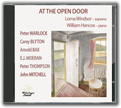
Bright Clouds has been recorded by Lorna Windsor, soprano and William Hancox, piano on the At the Open Door CD (these tracks may be heard below).
A Garland for Presteigne is a cycle of twelve songs by ten composers commissioned by the Presteigne Festival on the borders of Wales to celebrate its 21st birthday. We composers were asked for songs with a Welsh or border theme; being a resident of the Welsh borders, this suited me perfectly.
This song brings the cycle to an exhilarating conclusion. A significant other mid-Wales resident is the beautiful and brilliant bird of prey, the red kite. I felt its flight in the skies around my home in some way mimicked the ups and downs of the heart in the journeyings of human love. As such I had no other choice but to write the text myself, hence Red Kite Flying.
Performed and recorded wonderfully by Canadian soprano Gillian Keith, with pianist Simon Lepper, it has since been performed by many others, including celebrated baritone Roderick Williams.
—Adrian Williams
Although his work is somewhat out of fashion now, John Drinkwater (1882–1937) was best known in his time as a dramatist and poet. In the latter capacity he was one of the Dymock Poets – a loose literary group that also included Edward Thomas, Rupert Brooke and Wilfred Wilson Gibson, centred around the Gloucestershire village of Dymock between 1913 and 1915. Accordingly, perhaps it comes as no surprise that much of Drinkwater’s verse deals with rural subject matter, and indeed two of the song lyrics in Beauty’s Hour are in this category.
Three of the four set poems are of a lighter nature, in contrast to Birthright which laments how the transience of beauty has been with mankind since time immemorial. The last song in the group, Mamble, alludes to a real village of that name in Worcestershire, and with the lyric being of a mildly preposterous nature, its setting as something in the style of a music hall romp seemed rather appropriate!
The Two Interludes were written in 2022 for the Rotherhurst Piano Quartet.
The first interlude, Flower of the Morning, opens with a sustained violin solo and gradually the morning ‘awakens’ with the arrival of the other instruments and a quickening of tempo. The ending is reflective and is not unassociated with the opening mood.
Toccata Rotherhurst gives an ensemble the opportunity to exhibit lightness and deftness of touch and mood, and creates an ebullient encore.
In Spring 1951, Bax wrote this simple SATB arrangement of Happy Birthday To You on commission from Samuel Barber for Mary Zimbalist’s birthday.
The writer A. E. Coppard (1878–1957) is best known for his many volumes of short stories, produced regularly from 1921 almost up to the year of his death. Most often set in rural England, some of the tales were dramatised in the 1972 TV series Country Matters.
Less well known is Coppard’s poetry, and a volume of his Collected Verse was published in 1928. It was from this that the three poems set in the present publication were selected, and each has a link to one of the four seasons. The group begins with a somewhat dramatic song, reflected in the line ‘Gusty-galing Autumn comes’, and this is followed by a slower tempo one depicting an old man trudging across a field, ‘…ploughing through the frosty morn’. The final upbeat song alludes to the joys of a fine April day, where the narrator beseeches ‘Soft smiling time’ to ‘…hold back the showers…’.
Soft Smiling Time is dedicated, with gratitude, to Richard G. Hallas, who has been so supportive to me during my many years of association with the Fand Music Press. His expertise in music typography and cover artwork has been greatly appreciated.
—John Mitchell, September 2022
Elegiac Melody was composed in the summer of 2022 as a wedding anniversary present for my wife, Gillian. It was inspired by two of my favourite piano pieces – the Elegiac Melodies of Grieg and inhabits a similar sound world. It is of Grade 7 to Grade 8 ABRSM standard.
—Philip Mead, March 2023
 Previous announcements may be found in the Fand News Archive.