| "This is a generously filled disc of English songs embracing a period of over 80 years....and there is a real passion and commitment to the interpretations." | ||
| —Gary Higginson, BMS News |
Click the quotation text to discover what it refers to!
| "This is a generously filled disc of English songs embracing a period of over 80 years....and there is a real passion and commitment to the interpretations." | ||
| —Gary Higginson, BMS News |
Click the quotation text to discover what it refers to!


Fand IncWessex Press is a publisher of high quality sheet music, CDs and books, all focussing on accessible 20th Century and contemporary composers and concentrating mainly on first editions. Please use the tabs at the top of the page to explore the catalogue. Further details, such as information about ordering, can be found on the Contact/Info page.
I had never previously thought about composing a work for two violins until I became involved in the publication (by Fand) of the Four Bagatelles by Gordon Jacob. Being impressed by the effectiveness of this medium steered me towards writing some pieces of my own for two violins. By way of an antidote to all the negative vibes from the Covid Pandemic/Lockdowns, etc., I decided that something on the lighter side was a good option, and this collection of seven pieces was the result. They were composed in contrasting dance genres – from the classical era there is a Minuet and a Saraband; in the folk/traditional area I have included a Polka and Jig; and in more modern Latin styles are featured a Samba, Paso Doble and Tango. Each is not quite a full length dance as such, so hence the Cameo in the work’s title, and to avoid any awkward page turns for the players, all of the movements are set out on two facing pages of the score.
—John Mitchell, June 2021
Admirers of E. J. Moeran’s music will all agree as to the ‘rare gold dust’ quality to his work, and lament its scarcity.
This is particularly true of his piano music, which often seems akin to the watercolourist’s art with its intimate and picturesque delightfulness.
And now, thanks to the skill of John Mitchell, we have nine ‘new’ piano pieces from Moeran! These are arrangements of songs, and, in their new guise, stand alone as piano miniatures and thus are sure to be welcomed by all players of this composer.
The strong melodic lines and individual harmonic schemes of the originals are never lost sight of, but neither do the pieces ever become over complex, and so both the professional and amateur pianist will find here further music of rare gold dust!
Despite many glorious spring days in 2020 there was, of course, the stain of the pandemic underlying them. The music of Suite no 11 seeks to convey this in its often abruptly turning moods and colours.
This piece was written in 1961 as a Christmas present for the violinist David Martin (whose wife was the ’cellist Florence Hooton). Both were friends of Gordon Jacob and he wrote works for both of them, including a Concertino for violin, ’cello and string orchestra for their 25th wedding anniversary.
Four Bagatelles for two violins has been recorded for the first time on EM Records EMR CD043, Warp & Weft, the soloists being Midori Komachi and Sophie Rosa.
Illustrating the front cover is Frank Bayford’s 1970 painting Metamorphosis of Leaf and Cloud. It is reproduced here with his kind permission. We are also grateful to him for his drawing Apples and leaves in the Fall, which was produced especially for this publication, and it appears on page 5 [see sample pages, below].
Thanks are also due to Dr Geoff Ogram and Margaret Jacob Hyatt for facilitating the work to be published here for the first time. The intellectual copyright of the music remains with the Estate of the late Gordon Jacob.
—John Mitchell, October 2020
Whythorne’s Shadow was composed by E. J. Moeran (1894–1950) in 1931 and scored for strings and four woodwinds. The piece is based on a part-song by Thomas Whythorne published in 1571. Although dedicated to the conductor Anthony Bernard, there has been some speculation that the work is more in the way of an In Memoriam for Moeran’s friend, Peter Warlock. Almost exact contemporaries, they had shared a cottage together in the Kentish village of Eynsford from 1925 to 1928. When Warlock died unexpectedly in 1930 it undoubtedly affected Moeran profoundly, and it could well be that Whythorne’s Shadow was both a tribute and a means of exorcising Warlock’s influence. Moeran had probably become aware of the Whythorne original via a transcription of the part-song into modern notation that Warlock had made in 1927.
The present transcription of the piece for solo piano was made partly to commemorate the seventieth anniversary of Moeran’s death in 1950. The cover illustration is a portrait in oils of Thomas Whythorne and, dating from 1569, is one of the earliest painted of an English composer. Whythorne is also of note through having penned what is likely to be the earliest surviving autobiography (c. 1576) in the English language.
—John Mitchell, 2020
Whythorne’s Shadow is one of a pair of short orchestral pieces (the other being Lonely Waters) that Moeran wrote in 1931 as Two Pieces for Small Orchestra. Both pieces are based on existing melodies: Lonely Waters on a folksong and Whythorne’s Shadow on an Elizabethan tune. Both have been arranged for piano solo by John Mitchell and are available from Fand.
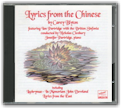
This is a fine arrangement, by the composer, of his well-known work for voice and string orchestra, setting seven Chinese poems from 1121 BC–650 BC. This version offers the piece to a wider range of performance and is a superb addition to our Carey Blyton collection and to English Song generally.
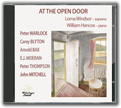
The original version of the work, with string orchestra accompaniment, has been recorded by Ian Partridge, tenor with the Britten Sinfonia on the Carey Blyton – Lyrics from the Chinese CD. A more recent recording, sung by Lorna Windsor, soprano accompanied by William Hancox, piano is also available on the At the Open Door CD (these tracks may be heard below).
Heart-shaped petals curved like the lip
Of a curling shell. A bell with a golden
Tassel for a tongue. Cream upon cream
Upon berries; swans’ wings tucked about dawn.
A forest of radiant buttercups guarding
A hillock of magic lawn. Sunbursts
Of rays translucent like water, gleaming
Green as dew-drenched blades. Sweetness
Of dusky moth-light scattered at noon.
Rebirth of blossom in green-apple time.
© 2020 Damaris West
Heart-shaped petals curved like the lip
Of a curling shell. A bell with a golden
Tassel for a tongue. Cream upon cream
Upon berries; swans’ wings tucked about dawn.
A forest of radiant buttercups guarding
A hillock of magic lawn. Sunbursts
Of rays translucent like water, gleaming
Green as dew-drenched blades. Sweetness
Of dusky moth-light scattered at noon.
Rebirth of blossom in green-apple time.
© 2020 Damaris West
 Previous announcements may be found in the Fand News Archive.