| …an imaginative and enormously effective piece… | ||
| — Musical Opinion |
Click the quotation text to discover what it refers to!
| …an imaginative and enormously effective piece… | ||
| — Musical Opinion |
Click the quotation text to discover what it refers to!


Fand IncWessex Press is a publisher of high quality sheet music, CDs and books, all focussing on accessible 20th Century and contemporary composers and concentrating mainly on first editions. Please use the tabs at the top of the page to explore the catalogue. Further details, such as information about ordering, can be found on the Contact/Info page.
As the year begins to turn toward Autumn, Fand Music Press presents a late Summer collection of new publications and other news.
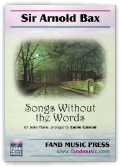
Fand is delighted to offer this splendid new volume, a most enterprising collection of some of Sir Arnold Bax’s greatest songs, arranged by the Italian pianist Ennio Caironi. The songs of Bax are hardly the best known portion of his œuvre at present, but this volume will be welcomed by pianists (and their audiences) wishing to explore them as solo piano arrangements and so to be beguiled by their extraordinary melodic invention and harmonic subtleties.
This lavish anthology includes arrangements for solo piano of ten of Bax’s songs, presented in chronological order of composition, and is best suited for pianists of at least Grade 7 standard. Each song arrangement is preceded by the full text of the original poem, for context, and the collection includes a detailed introduction by the arranger.
This new Bax Songs Without the Words issue extends Fand’s existing Songs Without the Words series, originally begun by John Mitchell with his arrangements of songs by Warlock (volume 1 and volume 2) and songs by Moeran.
Since mid-2024, Ennio Caironi has been making an extensive collection of superb keyboard recordings for the Fand website (see the September 2025 Friends of Fand news entry for more details); this volume represents his highly auspicious debut publication for Fand.
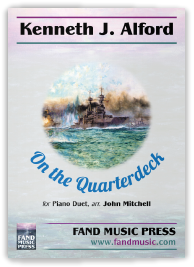
Because of his twenty marches composed for military band, Kenneth J. Alford has sometimes been referred to as ‘The British March King’. His real name was Frederick Joseph Ricketts, and he adopted a pseudonym to distinguish his renown as a composer from his career as a military musician. Born in London in 1881, and after training at Kneller Hall, he eventually became bandmaster of the Royal Marines, a post he held almost up until the time of his death in 1945.
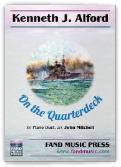
On the Quarterdeck is probably the best known of Alford’s marches after Colonel Bogey (with its fame boosted by being used in the 1957 film, The Bridge on the River Kwai). It was composed in 1917 and commemorated the naval Battle of Jutland that took place in the previous year. Although this fine march has already been arranged for piano solo, the present transcription for piano duet from the band score has allowed the countermelodies to be included, most of which were omitted from the former arrangement.
On the Quarterdeck is, in some sense, a companion piece or sequel to the earlier Out of the Blue by Hubert Bath: both are piano duet arrangements, with the Bath piece having RAF connections and the new Alford arrangement commemorating a naval battle.
Aside from his Alford arrangement, John Mitchell has composed two new original works that have now been published by Fand.
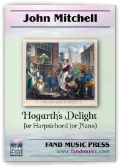
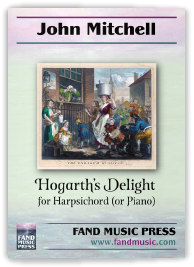
Dedicated to Ennio Caironi, Hogarth’s Delight is for harpsichord or piano. An original version of this piece was composed in 2005 for flute and harpsichord. Entitled Gin Lane, it was a musical portrait of a street scene in Hogarthian London. The work originated in an idea for a song before becoming an instrumental piece, when it had as a provisional title Hooked on Hook, referring to James Hook (1746–1827), the style of whose song The Lass of Richmond Hill was a source of inspiration for some of the melodic material.
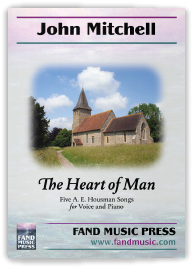
The Heart of Man is a cycle of five songs to words by A. E. Housman (1859–1936), a classical scholar who is now best known for his volume of verse A Shropshire Lad, first published in 1896. With their evocation of the English countryside, thwarted love and a yearning for things lost, his poems are probably still as popular today as when they first appeared. Their content and regular metres made them especially appealing to composers such as Arthur Somervell, Ralph Vaughan Williams, George Butterworth, John Ireland and E. J. Moeran to set to music.
The five songs in The Heart of Man focus on the various aspects of pessimism and negativity that permeate so much of Housman’s verse. The first song questions whether material prosperity in later years is counterbalanced by a loss of youthful innocence, whilst in the second the narrator describes a return to a rural scene from his earlier life, only to find his former friends there have already perished. The jangling church bells in the third song sound as a metaphor for an unfulfilled life, followed by a song that asks whether there is any point in carrying on in such a hopeless situation. The final song queries whether happiness can perhaps be illusory, concluding that “…The heart of man … was never happy long.”
Finally, we have two new publications of works by Peter Thompson.
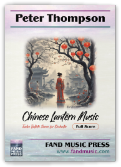
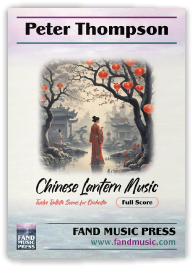
Chinese Lantern Music: Twelve Balletic Scenes for Orchestra was written for Anne Claxton and the Petersfield Area Youth Orchestra. It was first performed by that orchestra (under the baton of David Thomas) in the Petersfield Musical Festival, March 1992. This work is perfectly suitable for performance by school, youth or amateur orchestra.
String Quartet no 8, written in the spring of 2025, is a finely designed work in which the three movements form a cohesive, often joyous, whole.
 Previous announcements may be found in the Fand News Archive.