| …very adroitly scored… | ||
| — Music Teacher |
Click the quotation text to discover what it refers to!


Fand IncWessex Press is a publisher of high quality sheet music, CDs and books, all focussing on accessible 20th Century and contemporary composers and concentrating mainly on first editions. Please use the tabs at the top of the page to explore the catalogue. Further details, such as information about ordering, can be found on the Contact/Info page.

Fand Music Press is thrilled to announce that it has been awarded:
in this year’s SME News Southern Enterprise Awards.
Fand is pleased to announce three new publications from Peter Thompson:
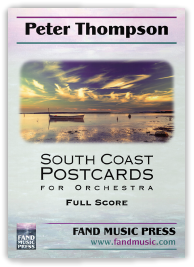
The score of South Coast Postcards for Orchestra was completed back in 1998. There are three postcards, and all are miniature tone poems; so in movement 1 a picture of kites flying over, and falling down, and being launched from the slopes of Butser Hill is presented. Number 2 visits Emsworth Harbour on an autumnal, rather overcast evening and number 3, Roller-Coaster, is an energetic contrast of movement and dipping fun.
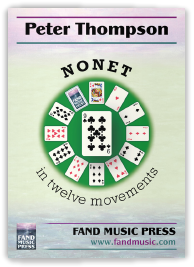
The Nonet from 2002 is scored for woodwind trio, horn and strings and consists of twelve short movements that are sometimes interconnected.
Finally, the Three Excursions for two flutes (or for flute and oboe) are whimsical excursions, jaunts, all marked ‘poco allegro’, and date from 1992.
April brings a fascinating pair of new releases from Fand:
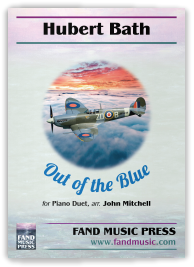
Hubert Bath was a composer of light music, writing works for the stage, silver screen and brass band. As a film composer he penned music to what is usually believed to be the first British talkie film: Alfred Hitchcock’s Blackmail in 1929. From that year on, he continued composing music for many films, writing for over thirty features up to 1944’s Love Story in the year before his death.
Today his best known work, at least from sheer exposure, is his march Out of the Blue, as it has been used continuously as the theme music for BBC Radio’s Sports Report programme since its inception in 1948.
Bath’s own piano solo arrangement of the piece contains a few awkward corners, and was not able to include some of the counter-melody material. This is what prompted John Mitchell to adapt the piece into piano duet format, so as to include more detail and hopefully make it more playable and easier to articulate.
Peter Thompson’s latest publication is for full orchestra and was completed in March 1999. It is scored for double woodwind (plus third flute/piccolo), brass, percussion (including piano) and strings.
Symphonietta Doppio consists of a single movement of contrasting material and two, basically opposite, tempi. This is where the ‘doppio’ in the title comes from: one tempo is ‘double’ the other.
There is thus a certain formal conflict.
Otherwise the music has the ambience of an overture and would be well placed to open a concert of symphonic music.
This February, Fand presents a bumper crop of important new releases:
Back in 2004, John Mitchell acquired the manuscript of Eric Thiman’s Sonata in One Movement for Piano. It turned out that this was a previously unknown Thiman work, and it is now being presented as an important première by Fand on the very centenary of its composition.
It is unknown whether this virtuosic work was ever performed during Thiman’s lifetime, but the work has nevertheless recently received a superb first performance by Zibo Li as part of his doctoral recital at the University of Miami. We are very fortunate to be able to present a video of that performance here on the Fand site and accompanying YouTube channel.
Christmas may have recently gone by… but that leaves plenty of time to find and rehearse something new and highly attractive for next Christmas! A new and very appealing (yet straightforward) piece for SATB choir is what we have here in the form of Philip Mead’s lullaby, Qui creavit cælum. Using a relatively uncommon (though far from unknown) text, this new carol setting is simple but deeply felt, and should fall well within the capabilities of most amateur choirs whilst nevertheless producing an enchanting effect on the audience. There is a simple piano or organ accompaniment.
Peter Thompson’s Autumn Sketchbook is the twelfth in a series of piano suites exploring the art of writing for the piano in fairly brief movements. Suite no 12 concentrates mainly on the reflective and colourful aspects of Autumn, rather than the stormy and winter-leaning traits, although one of the movements, Twirling Leaves, encourages a challenging briskness. The music is aimed at relatively advanced pianists of Grade 7 to 8 standard.
A career in conducting the Royal Ballet had some impact on the time that Constant Lambert was able to devote to composition, and his fame as a composer has been somewhat eclipsed accordingly. His most often heard work is the jazz-influenced The Rio Grande. We are pleased to introduce this composer to our catalogue via John Mitchell’s new arrangement for piano of Lambert’s Aubade Héroïque, originally for small orchestra. This was composed in 1942, partly as a 70th birthday tribute to Ralph Vaughan Williams, but also to capture in music an experience Lambert had had two years earlier, when an idyllic morning spent in the garden of a Dutch château was set against the backdrop of the German invasion of Holland in 1940 (the blissful nature of the occasion being clouded by distance gunfire).
Lambert only published three works for solo piano during his lifetime – a substantial Piano Sonata and two shorter pieces – and the present arrangement will add a further option to those pianists wishing to play his music.
Competent pianists of Grade 6 to 7 standard should enjoy tackling this arrangement.
Fand announces its first publications of the new year.
Three Welsh Folk Songs, arranged by Carey Blyton in 1972 and never before published, can be heard on the CD Carey Blyton – The folksong arrangements, where they were recorded by their dedicatee, Robert Ivan Foster. Fand’s top quality new edition is equally suitable for use with either harp or piano accompaniment.
We are delighted also to release an arrangement (for recorder and piano) of the Air and Two Eclogues by Peter Thompson, recently recorded (in their original guise for recorder and ukulele) by Donald Bousted and now available on the Barry Tone’s Fantastic Adventure CD.

Fand is rounding off 2021 with the release of a work by a new composer to the catalogue: Walter Leigh. Although now an unfamiliar name, he was a highly promising young English composer whose death in the Second World War was a major loss for British music. One of his most famous and successful compositions was the comic opera Jolly Roger (or The Admiral’s Daughter), which met with great critical success in the early 1930s and ran in London’s West End for 199 performances.
John Mitchell has arranged the Jolly Roger Overture for piano duet with characteristic panache. The resulting show piece is great fun and sets a splendidly nautical scene, complete with a humorous quotation from Rule, Britannia and even a wry dig at Beethoven’s 5th…
Fand Music Press is excited to present two new small works by Carey Blyton, one of them a new discovery.
The newly unearthed novelty is The Ballad of Lady Maynard and Dudin Brown. In 1971 Carey Blyton made an arrangement for choir of The Mistletoe Bough, which was subsequently recorded by Canzonetta and Jennifer Partridge (piano) on The Choral Music of Carey Blyton. Amongst his papers in the studio where he worked, Peter Thompson recently came across The Ballad of Lady Maynard and Dudin Brown, an apparently new choral work. Apparently, at some point, Carey Blyton decided to ‘arrange’ his arrangement of The Mistletoe Bough by composing new words and presenting them as a newly collected folksong—clearly with humorous intentions. The ‘new’ song would make a welcome ‘tongue-in-cheek’ filler to any choral programme and so Fand Music Press is delighted to present it to a wider public.
The second item is a previously unpublished fanfare for brass ensemble, Fanfara Pian’ e Forte. Written for Bandmaster Douglas Mackay and the Trumpeters of Kneller Hall, this is a welcome addition to the fanfares that bejewel British music in an illustrious tradition that included Elgar, Bax and Bliss.
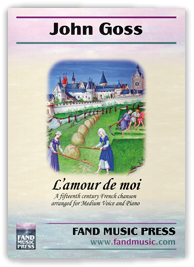
Fand is delighted to introduce a new name to the catalogue in the form of John Goss, who was best known as a lyric baritone in the first half of the twentieth century. A close friend of Peter Warlock in particular, Goss was heavily involved in reviving interest in traditional folksongs, which he orchestrated and performed himself.
L’amour de moi is a well-known fifteenth-century French chanson that John Goss published in an arrangement by Hubert Foss back in 1929. However, Goss independently wrote his own arrangement, pitched in a better key for medium voices than Foss’s version, and it was rediscovered in a manuscript dossier of songs, written in Goss’s own hand, in 2008. This Fand publication is the arrangement’s first appearance in print.
Update, December 2021: An audio recording is now available of the song being performed in its original French by Giles Davies (baritone) and John Mitchell (piano).
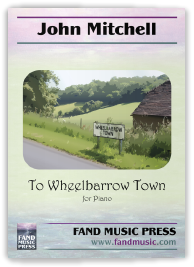
John Mitchell’s newest piece, To Wheelbarrow Town, is an evocative impression of place for Grade 6-level piano solo, and was written in part to mark the 80th birthday in August 2021 of John’s long-time friend, Frank Bayford.
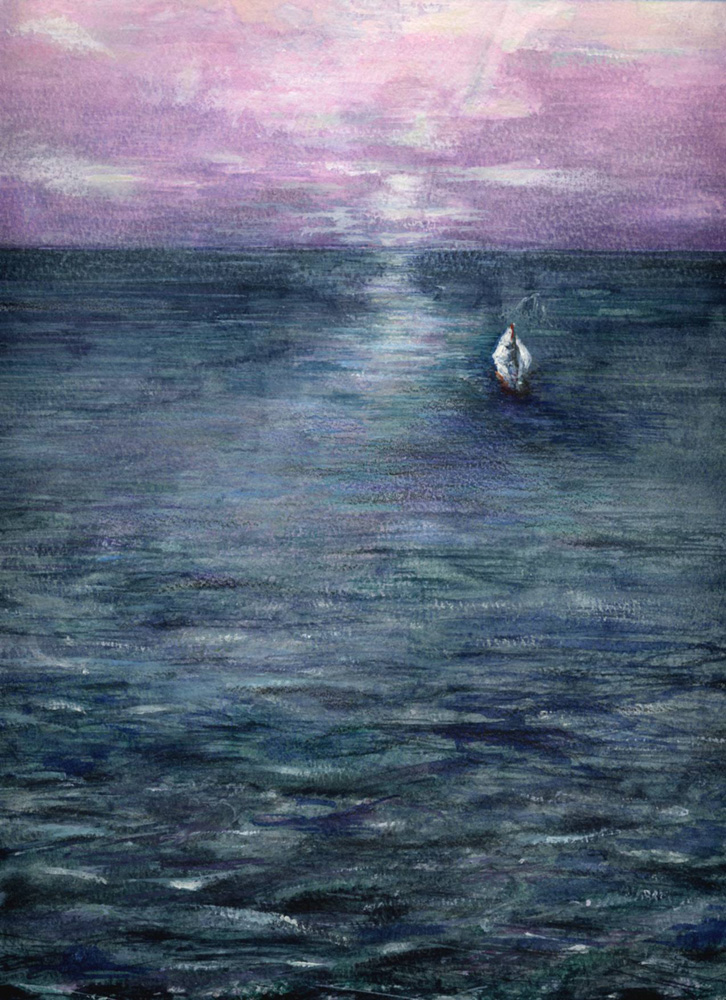
In terms of musical content, John writes: “Have you ever noticed how a certain area or view can have that special personal appeal that can’t quite be readily accounted for in words? Such is a place for myself, just a few miles from where I live in East Kent, where a quiet country lane approaches Wheelbarrow Town. The name itself is rather spurious in that the latter is actually a small hamlet, located just south of the village of Stelling Minnis. How it got its curious name seems to be somewhat shrouded in mystery; all that appears to be known about it is that in the eighteenth century a remote Baptist settlement was established there, and in the nearby burial ground there can still be seen three well preserved tombstones from that period. I like to think the piano piece I have written contains something of the magical and mystical nature that the location holds for myself, an aspect that is well captured in Richard Hallas’ wonderfully imaginative artwork on the cover.”
As a special bonus, John has made his own recording of the piece especially for the Fand website:
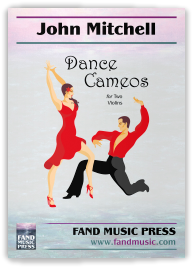
John Mitchell’s latest composition, Dance Cameos for Two Violins, was inspired by his recent work on the Four Bagatelles for Two Violins by Gordon Jacob, published by Fand last December. The frustrations of recent pandemic-related lockdowns have inspired a lightheated mood for this suite of seven dance fragments, which are based on classical, folk/traditional and Latin dance forms.
Dance Cameos is a seven-movement suite of dances in various styles for two violins, pitched at around Grade 5–7 level, and the movements are helpfully presented in a format that requires no page-turns.
 Previous announcements may be found in the Fand News Archive.