| …fragrant and full of character – beautiful! | ||
| — Piano |
Click the quotation text to discover what it refers to!
| …fragrant and full of character – beautiful! | ||
| — Piano |
Click the quotation text to discover what it refers to!


Fand IncWessex Press is a publisher of high quality sheet music, CDs and books, all focussing on accessible 20th Century and contemporary composers and concentrating mainly on first editions. Please use the tabs at the top of the page to explore the catalogue. Further details, such as information about ordering, can be found on the Contact/Info page.
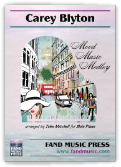
John Mitchell’s piano arrangements in Mood Music Medley, a volume of orchestral music by Carey Blyton, seek to give a wider audience the chance to hear (and to play) music of charming melodic invention and skilful mood presentation which was mainly originally written to fulfil publishers’ stocks of library music.
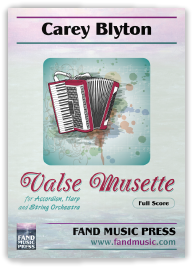
Thus can pianists relish, for example, the ‘Parisian left bank’ in Valse Musette and 18th century pastiche in the Minuet for Octet, and catch glimpses of the old music hall in Music Hall Memories.
There are many differing mood evocations in this Mood Music Medley and they are likely to prove as popular as the original orchestral versions were, as recorded by session players in the 1960s on Carey Blyton – Film & Television Music (1/4).
Note that this collection includes a slightly more demanding (Grade 6+) arrangement of Girl Friday, which John Mitchell recently arranged separately for easy piano (Grade 4–5).
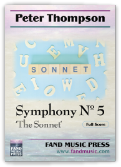
Peter Thompson’s Symphony no 5, ‘The Sonnet’ is so named as it reflects the sonnet form. Thus, movement 1 is the volta, movement 2 is a development and exploration of the ‘theme’, and in movement 3 the issue seeks resolution in a short rhyming couplet.
This is a brief but pithy symphony which was sketched and orchestrated between February 2023 and March 2024 and is scored for traditional symphony orchestra.
Fand announces a varied selection of pieces by Peter Thompson and Carey Blyton this Easter:
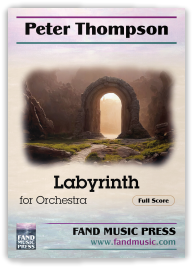
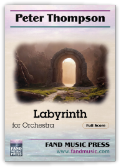
Labyrinth was completed in February 2021 and is a single movement work for full orchestra. Its ‘labyrinthine way’ might be suggested by the weaving, developing and return, often slightly alarmingly, of different musical material. This creates a gradual building of tension, but there is release in the final bars, perhaps into spacious skies and seas…
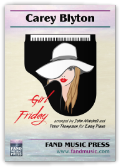
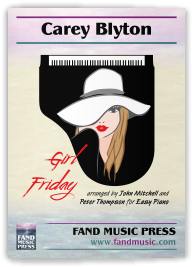
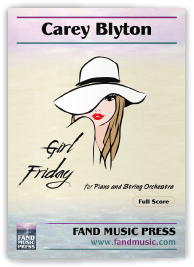
Carey Blyton had a rare talent for melodic invention. Girl Friday was originally commissioned by Boosey & Hawkes, and was originally scored for piano and string orchestra in 1974. The original version can be heard on the Carey Blyton – Film & Television Music (1/4) CD, available from Fand.
However, the chic melodic charm and captivating immediacy of Girl Friday – with her slightly South American flavour – seemed to call out for a solo piano arrangement, particularly one playable by the Grade 4–5 pianist. Hence this special Fand edition of the work, arranged by John Mitchell and Peter Thompson.
Note that a somewhat more sophisticated and demanding (Grade 6+) arrangement of Girl Friday, also by John Mitchell, is to be found in the Mood Music Medley collection.
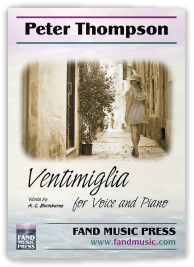
With words from a roundel by A. C. Swinburne written in 1883, after he had retired to The Pines, Putney, the poem explores a ‘living memory’ of over 20 years before, when Swinburne had visited Italy and Ventimiglia:
This new setting is dedicated to Lorna Windsor (Web site), who in 1981 premiered Peter Thompson’s Four Swinburne Pictures.


Having been awarded Sheet Music Publisher of the Year two years running by the SME News Southern Enterprise Awards, Fand Music Press’ reputation for quality and enterprise in music publishing has now been recognised internationally by its being granted a Corporate LiveWire Global Award for:
In such a competitive market, Fand is delighted to learn of this recognition for its service to contemporary classical music publishing.
The award text (also available to download as a PDF) notes in particular “the quality of the publisher’s platform” and how it is “easy to explore the sheet music, recordings, and books that Fand Music Press offers in its impressive catalogue” of more than 40 composers, authors and recording artists.
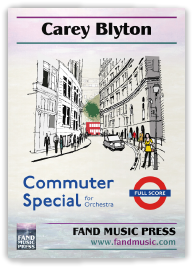
Fand is excitied to announce a trio of orchestral character pieces by Carey Blyton, plus another new song cycle by John Mitchell and a didactic suite of piano pieces by Adrian Williams:
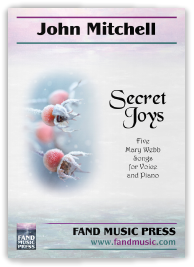
Mary Webb (1881–1927) had a great love of her native Shropshire, where she spent most of her short life. Her most significant writing dates from her mid-thirties, and her collected poems were not published until shortly after her death. Much of her verse focuses on a detailed observation of the rural Shropshire landscape, with some notable descriptions of nature. The five poems selected for Secret Joys are in this category, and the songs to which they give rise have all been given titles referencing a colour. The name of the collection itself alludes to the original title of the fourth set poem: The Secret Joy.
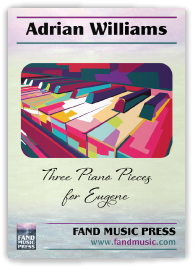
Continuing with our Adrian Williams series, we are delighted to present these Three Piano Pieces, a charming, rather English Sicilienne sandwiched between two very vivacious, fast moving numbers, Little Toccata and Scherzetto.
The set is very pianistically laid out and would suit aspiring Grade 6+ players; indeed they were originally written for Adrian’s son, Eugene, when he was about 10 years old. We are happy to report that he enjoyed them very much!
These three orchestral works were written for different forces and are excellent repertoire, encores or ‘fillers’ for any orchestral concert programme. They are wonderfully tuneful and are thus memorable from a first hearing, and are sure to be loved by most audiences.
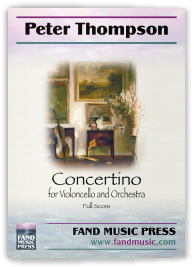
Peter Thompson’s ’Cello Concertino was written between 2000 and 2001, and is in three linked movements which run continuously. The second movement references music Thompson wrote at Cambridge Arts College in the early 1970s, specifically the Two Sonnets for Small Orchestra, which were prefaced by words of James Joyce: “Welladay! Welladay! For the winds of May! Love is unhappy when love is away.” The Concertino is now available as both a full orchestral score and as a large-format Conductor Score. A piano reduction is also available for purchase. The solo ’cello part is included, and orchestral parts are available on request.

Fand Music Press is thrilled once again to announce that – for the second year running! – it has been awarded:
in SME News’ seventh annual Southern Enterprise Awards.
Also released this month…
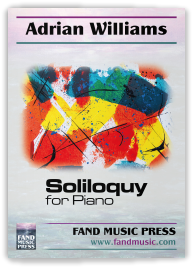
Fand presents the third work to be published in our ongoing Adrian Williams collection. This piece was commissioned by the Gloucester Music Society and is dedicated to its Chairman, Christine Talbot-Cooper. It was subsequently premiered by Maria Marchant in the Ivor Gurney Hall, Gloucester on November 3rd, 2019. Stylistically contemporarily relevant, Soliloquy also has deep roots in an older tradition and is fabulously written by a composer whose own pianism is of the highest order.
Fand Music Press has three new releases for July, all of them involving the voice. Gary Higginson’s setting of Two Czech Carols bring together a pair of Christmas carol arrangements, both for three voices, that he wrote for different purposes quite some years ago. One is entirely a cappella; the other also has keyboard accompaniment.
Philip Mead’s atmospheric setting of words from Samuel Taylor Coleridge’s The Nightingale is most unusual for being a four-part (with divisi) choral work accompanied by solo flute. This evocative and joyous piece was Philip’s first tonal composition after previous ventures into the avant garde, and it presents the audience with a mystical yet accessible representation of its poetic inspiration.
Finally, John Mitchell adds to his growing portfolio of short song cycles to verse by English writers with Bright Clouds, a setting of four poems by Edward Thomas. This writer had only just embarked on his poetic career when his life was cut tragically short in the First World War. The four poems presented here all allude, perhaps nostalgically, to nature in rural England, the first one mentioning locations in Essex where Thomas was posted after enlisting.
This month, Fand Music Press presents a new choral work and a new song. Philip Mead’s setting of Ave Maris Stella is a plaintively simple one for upper voices (SSA) only, with piano accompaniment.
Red Kite Flying is Adrian Williams’ contribution to A Garland for Presteigne, a cycle of twelve songs by ten composers commissioned by the Presteigne Festival on the borders of Wales to celebrate its 21st birthday. This is the concluding song from the cycle, and uses a musical depiction of the red kite, a familiar Welsh resident, as a metaphor for flights of the human heart. Both music and words are by the composer. Already performed by a number of high-profile professional singers such as Gillian Keith and Roderick Williams, the song may be sung by female or male singers.
For its first set of announcements of 2023, Fand is delighted to have a bumper collection of eight new publications, ranging from several new sets of songs composed by John Mitchell to instrumental works by Philip Mead and Peter Thompson, not to mention a little novelty by Sir Arnold Bax…
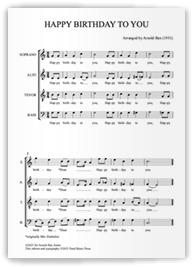
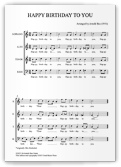
In Spring 1951, Sir Arnold Bax wrote a simple SATB arrangement of Happy Birthday To You on commission from Samuel Barber for Mary Zimbalist’s birthday. Fand now issues the arrangement as an affordable single-sheet publication.
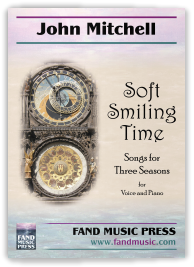
A. E. Coppard is best known for his short stories, but he was also a poet, and the three poems set to music in Soft Smiling Time are taken from his Collected Verse, published in 1928. Each song has a link to one of the four seasons, though Summer is not icumen into this particular collection. Richard Hallas, Fand’s designer, webmaster and long-term music editor/setter, is extremely proud and privileged to be the dedicatee of this delightful triptych.
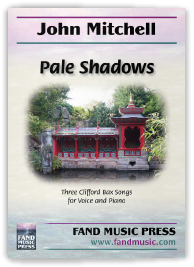
Clifford Bax was Sir Arnold Bax’s younger brother, and a playwright, poet and author of many books. One of his earlier publications, Twenty Chinese Poems, forms the basis of Pale Shadows, which sets two songs from Bax’s original 1910 collection and one from a 1916 update that added a further five poems to the collection. The first and last songs are descriptive pictures of scenes at evening and night respectively, whereas the longer middle song also has a narrative quality.
John Drinkwater was a dramatist and poet whose verse frequently dealt with rural subject matter, and two of the songs in Beauty’s Hour fall into this category, one being concerned with the Cotswolds and the other specifically with the Worcestershire village of Mamble. The collection features four songs of a generally light-hearted nature, though one song has a more serious theme.
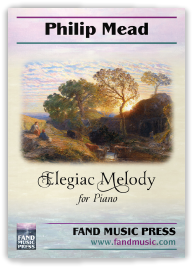
Philip Mead’s Elegiac Melody was inspired by Grieg’s similarly titled piano pieces, and inhabits a similar sound-world. Written for his wife in the summer of 2022 as a wedding anniversary gift, the piece is suitable for pianists of Grade 7 or higher standard.
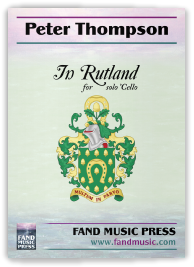
In Rutland, for solo ’cello, was written in Ketton, Rutland, in the winter of 1999. First published the following year, this new 2023 edition has been significantly enhanced with minor notational errors corrected. It is a five-movement suite ranging from a meditavely free, Andante amabile first movement to a virtuosic and joyful Presto finale. The work is a welcome addition to the unaccompanied ’cello repertoire and is of a similar level of difficulty to the variable demands made by the J. S. Bach unaccompanied suites.
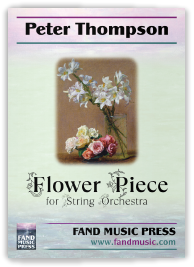
Flower Piece for string orchestra was written in 1979 and first performed at the Guildhall School of Music and Drama in 1981. It is in three movements, the third of which becomes a kind of envoi containing music from all three movements.
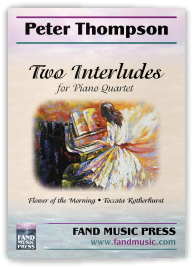
The Two Interludes were written in 2022 for the Rotherhurst Piano Quartet. The first interlude, Flower of the Morning, opens with a sustained violin solo and gradually the morning ‘awakens’ with the arrival of the other instruments and a quickening of tempo. The ending is reflective and is not unassociated with the opening mood. Toccata Rotherhurst gives an ensemble the opportunity to exhibit lightness and deftness of touch and mood, and creates an ebullient encore.
Fand is proud to announce another clutch of publications for September, most of them by Peter Thompson:
Thirty years after the publication of the original Hope and Fear for five-part professional choir, Peter Thompson has now produced a brand new reworking of the piece for Baritone solo and String Orchestra (with an arrangement for Baritone solo and Piano also available).
Fand’s designer, webmaster and long-term editer/setter of many music editions, Richard Hallas, feels enormously privileged to be the dedicatee of this superb new pair of arrangements.
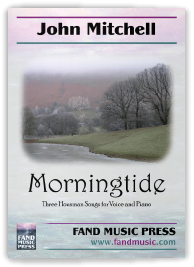
Morningtide is a set of three songs by John Mitchell to texts by A. E. Housman. Because the majority of poems from Housman’s A Shropshire Lad have been memorably set to music already, for Morningtide John Mitchell deliberately avoided this source and instead set a single poem from each of Housman’s three subsequent, lesser known collections of verse. The collection’s title reflects the fact that all three songs relate to early morning.
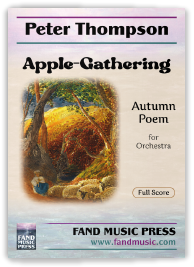
Peter Thompson’s Apple-Gathering, an Autumn Poem, was composed in, and between, two autumns – those of 2014 and 2015. However, the kernel of the material came much earlier and from a setting of words by Damaris West, Apple-Gathering, a poem originally written in 1976 and set for voice and piano in the summer of 1985. The orchestral version is an entirely new score for double woodwind, two horns, one trumpet, percussion, timpani and strings.
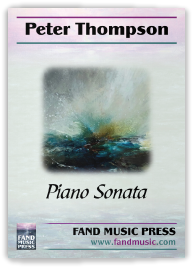
The Piano Sonata is a new work by Peter Thompson, completed in April 2022. It is in three movements, of which the first is the most extensive. Virtuosic at times and spilling over onto three and four staves, the sonata conducts an ‘argument’ through its thematically linked movements and ends in brilliant light.
 Previous announcements may be found in the Fand News Archive.