Click the quotation text to discover what it refers to!
Click the quotation text to discover what it refers to!


Fand IncWessex Press is a publisher of high quality sheet music, CDs and books, all focussing on accessible 20th Century and contemporary composers and concentrating mainly on first editions. Please use the tabs at the top of the page to explore the catalogue. Further details, such as information about ordering, can be found on the Contact/Info page.
“Mask” for piano by Arnold Bax was written on July 22, 1912 (the same month Nympholept was composed), approximately one month after the arrival in London of Serge Diaghilev’s celebrated “Ballets Russes,” for whom Bax had written the unperformed and unpublished ballet Tamara, composed between July and November 1911.
Hitherto thought lost, we have Nick Barnard to thank for discovering the manuscript in a sale at Hanson’s and having the forethought to copy it from the auction house’s catalogue.
“Mask” was dedicated to Gustav Holst’s cousin, Mary Lediard.
This edition is edited by Nick Barnard and carries an insightful Introduction by the pianist Ennio Caironi, who has made the first recording of the piece.
Fand Music Press has recently incorporated the Wessex Group. This was a creative group for composers to meet, discuss and promote their work, the idea of which was masterminded by John Barton Armstrong in the 1980s.
Wessex Group concerts were thus promoted both locally and on London’s South Bank and creative forums were held. As a result many first performances were given, and since that time Fand has been publishing and promoting Barton Armstrong’s work (with a view to publishing a complete edition) alongside the music of other Wessex composers.
It was always JBA’s intention that the Wessex Group, along with his own work – both music and words – should thrive and be self-sustaining. We are now continuing that ambition by joining Fand Music Press with the Wessex Group, officially: hence Fand IncWessex.
As the year begins to turn toward Autumn, Fand Music Press presents a late Summer collection of new publications and other news.
Fand is delighted to offer this splendid new volume, a most enterprising collection of some of Sir Arnold Bax’s greatest songs, arranged by the Italian pianist Ennio Caironi. The songs of Bax are hardly the best known portion of his œuvre at present, but this volume will be welcomed by pianists (and their audiences) wishing to explore them as solo piano arrangements and so to be beguiled by their extraordinary melodic invention and harmonic subtleties.
This lavish anthology includes arrangements for solo piano of ten of Bax’s songs, presented in chronological order of composition, and is best suited for pianists of at least Grade 7 standard. Each song arrangement is preceded by the full text of the original poem, for context, and the collection includes a detailed introduction by the arranger.
This new Bax Songs Without the Words issue extends Fand’s existing Songs Without the Words series, originally begun by John Mitchell with his arrangements of songs by Warlock (volume 1 and volume 2) and songs by Moeran.
Since mid-2024, Ennio Caironi has been making an extensive collection of superb keyboard recordings for the Fand website (see the September 2025 Friends of Fand news entry for more details); this volume represents his highly auspicious debut publication for Fand.
Because of his twenty marches composed for military band, Kenneth J. Alford has sometimes been referred to as ‘The British March King’. His real name was Frederick Joseph Ricketts, and he adopted a pseudonym to distinguish his renown as a composer from his career as a military musician. Born in London in 1881, and after training at Kneller Hall, he eventually became bandmaster of the Royal Marines, a post he held almost up until the time of his death in 1945.
On the Quarterdeck is probably the best known of Alford’s marches after Colonel Bogey (with its fame boosted by being used in the 1957 film, The Bridge on the River Kwai). It was composed in 1917 and commemorated the naval Battle of Jutland that took place in the previous year. Although this fine march has already been arranged for piano solo, the present transcription for piano duet from the band score has allowed the countermelodies to be included, most of which were omitted from the former arrangement.
On the Quarterdeck is, in some sense, a companion piece or sequel to the earlier Out of the Blue by Hubert Bath: both are piano duet arrangements, with the Bath piece having RAF connections and the new Alford arrangement commemorating a naval battle.
Aside from his Alford arrangement, John Mitchell has composed two new original works that have now been published by Fand.
Dedicated to Ennio Caironi, Hogarth’s Delight is for harpsichord or piano. An original version of this piece was composed in 2005 for flute and harpsichord. Entitled Gin Lane, it was a musical portrait of a street scene in Hogarthian London. The work originated in an idea for a song before becoming an instrumental piece, when it had as a provisional title Hooked on Hook, referring to James Hook (1746–1827), the style of whose song The Lass of Richmond Hill was a source of inspiration for some of the melodic material.
The Heart of Man is a cycle of five songs to words by A. E. Housman (1859–1936), a classical scholar who is now best known for his volume of verse A Shropshire Lad, first published in 1896. With their evocation of the English countryside, thwarted love and a yearning for things lost, his poems are probably still as popular today as when they first appeared. Their content and regular metres made them especially appealing to composers such as Arthur Somervell, Ralph Vaughan Williams, George Butterworth, John Ireland and E. J. Moeran to set to music.
The five songs in The Heart of Man focus on the various aspects of pessimism and negativity that permeate so much of Housman’s verse. The first song questions whether material prosperity in later years is counterbalanced by a loss of youthful innocence, whilst in the second the narrator describes a return to a rural scene from his earlier life, only to find his former friends there have already perished. The jangling church bells in the third song sound as a metaphor for an unfulfilled life, followed by a song that asks whether there is any point in carrying on in such a hopeless situation. The final song queries whether happiness can perhaps be illusory, concluding that “…The heart of man … was never happy long.”
Finally, we have two new publications of works by Peter Thompson.
Chinese Lantern Music: Twelve Balletic Scenes for Orchestra was written for Anne Claxton and the Petersfield Area Youth Orchestra. It was first performed by that orchestra (under the baton of David Thomas) in the Petersfield Musical Festival, March 1992. This work is perfectly suitable for performance by school, youth or amateur orchestra.
String Quartet no 8, written in the spring of 2025, is a finely designed work in which the three movements form a cohesive, often joyous, whole.
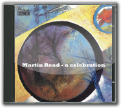
The Martin Read Foundation has been involved in the production of a new Martin Read – A Celebration CD, launching on 27th April 2025 and featuring exclusively the music of Martin Read, an important Fand composer who tragically died suddenly in 2012. The new CD, full details of which can be found on this site, features nine works, half a dozen of which have hitherto not been published, but which Fand is now bringing before the public to coincide with the launch of the new CD. Indeed, every work on the new recording is now published by Fand. The newly published works are:
The CD also contains recordings of Autumn, Drawing Details in an Old Church and The Angel of History, which were already published by Fand.
(The Four Interludes appear as part of the full cantata on the CD, not as a separate work.)
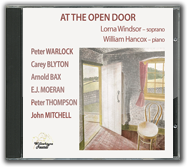
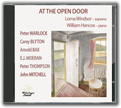
On the subject of CDs, Fand has also been involved in the production of an exciting new CD entitled At the Open Door. Recorded by Lorna Windsor, soprano and William Hancox, piano, the CD contains some rare material very close to the spirit of Fand, including recordings of the following actual Fand publications:
In addition to those Fand-published pieces, the CD also contains recordings of the following works:
Many tracks from the CD may be previewed on this site, and the disc itself is available for purchase at a very reasonable price!
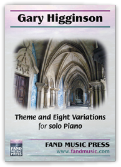
Also published by Fand this Easter is Gary Higginson’s Theme and Eight Variations for solo piano, aimed at pianists of approximately Grade 7 standard.
Although recently revised and newly published, this work has actually been in existence for a long time and is one of the composer’s earliest compositions, having been written initially when Gary Higginson was a student of Edmund Rubbra in the early 1970s. It was his first major composition exercise, although its importance and significance only revealed itself later. The work actually has a mild Christmas flavour, in that the original theme on which it is based was written on Christmas Eve 1970, and was originally considered a carol. The piece was revised somewhat back in 1990, and has undergone a few more small revisions in time for its publication in 2025.
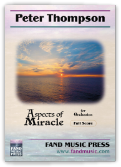
Finally, Fand’s collection of new publications this Easter is rounded off by Peter Thompson’s Aspects of Miracle for orchestra. Completed in February 2025, it is a short single-movement work whose title – the composer hopes – conveys the message of the music.
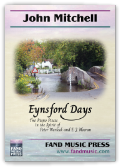
A century ago this month, Peter Warlock became the tenant of a cottage in Eynsford, Kent, and was joined there by his friend, fellow composer E. J. Moeran. This period of shared habitation marked the beginning of the ‘Warlock Legend’: a time of riotous living with an open house policy to all kinds of outré visitors. It was a productive time for Warlock; less so for Moeran, who found the situation at the cottage too distracting to permit significant creativity. The shared tenancy lasted for only a relatively brief period of under three years, but it was a notable time during which Warlock composed his best-known work, Capriol.
John Mitchell’s latest publication, Eynsford Days, brings together two of his compositions in styles that pay tribute to both Warlock and Moeran individually. Both pieces were written some time ago: the Warlock tribute was composed as long ago as 1976 for saxophone quartet, but has since been rearranged for several different instrumentations, and the piano solo version published here is brand new. The Moeran tribute piece was originally written in 2006, and both individual compositions have been paired in this new publication to commemorate the centenary of the start of the interesting Eynsford-based joint period in Warlock’s and Moeran’s association.

Fand Music Press has recently won yet another award. This time, as part of Acquisition International Magazine’s 2025 Global Excellence Awards, Fand has been awarded:
Remarkably, in the space of only half a year, pianist Ennio Caironi has undertaken and completed the recording of Peter Thompson’s entire published output of solo piano (and other keyboard) music. The recordings may all be listened to on this site, just by browsing Peter’s appropriate publications.
For ease of access, though, and to commemorate this milestone, here is a list of all of Peter’s solo keyboard works, each of which now has at least one associated recording performed by Ennio:
Ennio has also provided his own recording of John Mitchell’s volume of piano arrangements of songs by E. J. Moeran, Songs Without the Words.
The tail end of 2024 sees the publications of a couple of new works by Peter Thompson, though only one of them is newly written.
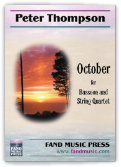
October for Bassoon and String Quartet was composed back in October 1991. The work is in a single rhapsodic movement, sometimes darkly dreaming, at other times light-splashed with colour and joy – reflecting, therefore, aspects of the month of October.
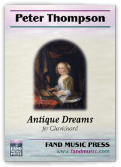
Antique Dreams, by contrast, is a new work, though its title and unusual choice of instrument is suggestive of autumnal thoughts of a different kind. Written for solo Clavichord, it is a sequence of five short, delicate movements that evoke music of earlier ages but with distinctly modern overtones.
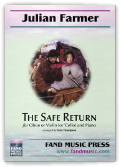
The Safe Return is a delightfully idiomatic folk tune written by Julian Farmer, poet and skilful folk musician. Peter Thompson has arranged the tune for either oboe/violin or ’cello with piano accompaniment. The score comes with all instrumental parts included.


Having previously been awarded Sheet Music Publisher of the Year for two years running by the SME News Southern Enterprise Awards, Fand Music Press’ is thrilled to have now repeated this achievement with the internationally recognised Corporate LiveWire Global Award, which it has just been awarded for the second year in a row:
Once again, Fand is delighted to receive this recognition for its services to contemporary classical music publishing in such a competitive market.
The award text again notes in particular “the quality of the publisher’s platform” and how it is “easy to explore the sheet music, recordings, and books that Fand Music Press offers in its impressive catalogue” of more than 40 composers, authors and recording artists.
John Mitchell’s Barcarolle Blanche is an attractive light piece for pianists of Grade 6 standard, and is accompanied on this site by a recording of the composer’s own performance of it. The work was written to mark a friend’s 75th birthday, and consequently is 75 bars long!
It was written as a kind of complement or follow-up to a previous Barcarolle Noire, written for another friend’s 80th birthday, and is much brighter in mood than the earlier work.
Summer’s Hue is a song cycle setting four poems by Edward Shanks. Shanks was best known as a war poet in World War I, but the songs in this collection are not based on his war poetry. On the contrary, the settings have mostly cheerful and naturalistic subjects. The first song recalls a youthful romantic moment in the East Sussex village of Fletching; the second is an observation of a natural scene. The third song, which is the most wistful of the set, considers the persistence of the beauty of nature after our own passing. The final song, in the style of a polka, sees the poet luring a girl away from the crowds and the light for a discreetly private dance…
Peter Thompson’s latest composition takes the form of another Suite for piano, the thirteenth in the series to date. Written in May, Suite no 13: ‘Greenwood Tales’ tells of moods and images glimpsed, fancifully and briefly, from a Maytime of bright blossom and burgeoning greenery. The music suits pianists of Grade 6–8 standard.
Also written by Peter Thompson, though not so recently, is a little part-song for women’s choir (SSA voices) called The Moon. The music of this piece was recently rediscovered: composed back in 1984, it was typeset ten years later and readied for publication back in 1994. However, copyright issues relating to the poem meant that it could not be issued at the time. Rediscovered by accident just recently, the former copyright problems no longer existed, so the piece is finally being issued on the fortieth anniversary of its composition! As for the piece itself, it came about after Peter Thompson was introduced to the director of a ladies’ choir in St Albans, The Laurel Singers. She informally asked for a new piece for the choir to perform, and Peter obliged.
Wearing his writing rather than his composing hat back in the 1990s, Carey Blyton came up with a series of ten children’s stories, collectively entitled The Doggy Tales of Arnold, about a small dog with a massively outsize bark. Despite the fact that one of the stories was turned into a TV programme narrated by the much loved Willie Rushton (this was one of his last pieces of TV work before his unexpected death), the stories never found a publisher during Carey’s lifetime. This changed in 2018 when Austin Macauley Publishers decided to publish, in a single volume, the two of the stories that had already been fully illustrated by Maurice Stevens, Carey’s collaborator. There is an interesting account of the background to these stories on the official Carey Blyton website.
As of mid-2024, however, Austin Macauley Publishers relinquished the rights to Arnold back to Carey Blyton’s estate, and as a consequence the existing book can now be sold by Fand Music Press. It is available in both paperback and hardback formats. September update: The ebook (supplied as a PDF file) is also now available once again.
 Previous announcements may be found in the Fand News Archive.